Home / Blog / Strength training
How to Do Your First Pull-Up

By Zoe Schwartz, ACE Certified Personal Trainer and Behavior Change Specialist
· 6 min read
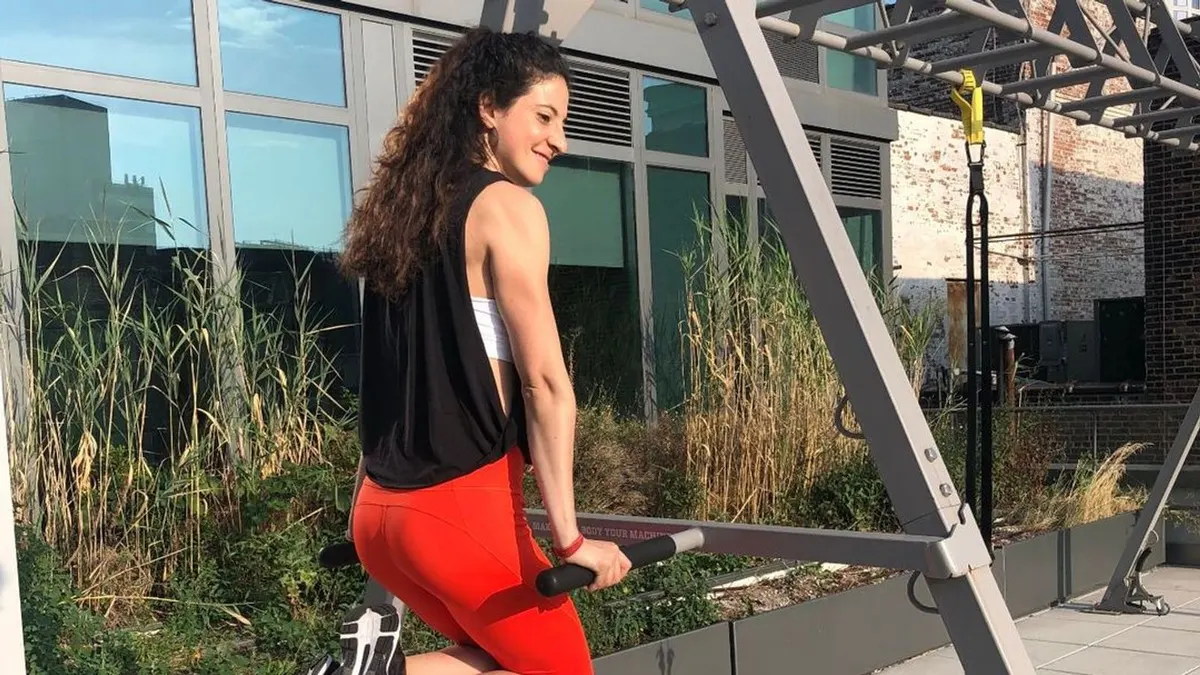
Most women can learn to do a pull-up, and the most direct way there is to practice the hardest part of the pull-up itself: start with an underhand chin-up grip, lower yourself slowly for five seconds, hold at the top, make a couple of real attempts even if you only get partway up, and build your grip and core so nothing else gives out first. Expect it to take months, not weeks.
For a long time I trained everything around the pull-up: the assisted pull-up machine, every kind of row, and later band-assisted pull-ups. I got much stronger at all of them and was still nowhere close to doing a real pull-up. But I felt strong and had back muscle definition, so I wasn’t sweating it.
What changed my thinking was learning from my coach Alex Kanellis at Landmine University that getting stronger at something and getting skilled at something are not the same. The research backs this up: in a study of 28 elite college swimmers, all women, the number of lat pulldowns they could do had almost no relationship to the number of pull-ups they could do, and the authors advised against swapping one for the other. The machine is useful for building your back, but it doesn't teach your body to move itself up to a bar.
I'd love to tell you about the day I did my first unassisted pull-up, but I don't remember it. It happened sometime in the last year, with an underhand grip, on a completely ordinary day, and I wasn't even surprised that I could do it. I've been working out for 20+ years and working professionally as an ACE-certified personal trainer for 10+ years, so it wasn't that I couldn't get strong. I just never chose to focus on the pull-up until recently. After years of believing I never would, I decided “why not?” When things are well paced and progress naturally, you get there: one day you just try, and you're there. You just have to be in the arena.
The women I work with who want a pull-up usually come to me already putting in the work. One current client who loves rock climbing shared, "I used to do 10 pull-ups, and now I can barely do one." Another said she goes to the gym and wonders, "Is it working?"
What doesn't get you your first pull-up, and what does
Here's the short version. These build your back, but on their own they won't get you your first pull-up:
- The assisted pull-up machine
- Lat pulldowns
- Rows of every kind: cable, barbell, single-arm
- Band-assisted pull-ups
- Grinding out as many pull-up attempts as you can every day
These three do:
- Slow negatives: lower yourself from the top for five seconds.
- Holds at the top: one to three seconds, chin over the bar.
- Bodyweight pull-up attempts: two tries, even if you only get partway up.
Rows still earn their place for back strength and posture, which is why they stay in my clients' programs. They just aren't the skill.
Why slow lowering (negatives) is the most direct way to your first pull-up
The slow lowering phase, which coaches call the eccentric and most people call a negative, was the unlock for me and my clients. You don't even do the pull-up. You get to the top, by stepping up on a box or jumping, and lower yourself as slowly as you can, aiming for five seconds. You can lower more than you can lift, so you're training the exact movement with more load than you could pull on your own.
The research agrees: a systematic review of 20 randomized trials found that heavy eccentric training builds more strength than lifting-focused training, with gains that are specific to how you train.
The second piece is holding at the top for one to three seconds, chin over the bar. That's your sticking point, and holding there builds strength exactly where you need it.
Why I'd skip the resistance band
I'd rather you jump to the top and lower slowly than lean on a band. A band is stretched the most at the bottom, so it helps the most at the bottom, and the hardest part for most women comes after that.
What to work on before you can do a pull-up: grip and core
Every time a client can't do something yet, I ask what the limiting factor is and train that first. For the pull-up, the first one is simply holding on. Bar hangs build grip strength and the confidence to be up there, and working toward 30 seconds to a minute is a good place to be. The second is your core: a hollow body hold teaches you to keep your body tight in one line instead of swinging, which makes everything on the bar easier.
How to train for your first pull-up each week
Here's the directional guidance I give the women I work with. Where you start depends on what you can do today, so treat these numbers as a starting point, not a prescription.
| Where you are | What to do | How much |
|---|---|---|
| Can't hang from the bar for 30 seconds yet | Bar hangs | 2 to 3 rounds, building from whatever you can hold toward 30 to 60 seconds |
| Hollow body holds | As part of your core work | |
| Can hang for 30 seconds | Chin-up negatives | 4 to 6 total, lowering for five seconds each, split across two or three sets. I wouldn't go past six. |
| Holds at the top | 1 to 3 seconds, chin over the bar, then come down and reset | |
| Pull-up attempts | Two tries, as high as you can get. Partial range counts. |
How often: two to four times a week, for ten minutes or less. Pull-up work goes first in a session while you're fresh, or on its own as a short movement snack on a day you're not lifting. Frequent, low-pressure exposure works better than one exhausting session, so some days that's two attempts, and then you move on with your life.
How it progresses: I don't give my clients everything at once. We usually spend about four weeks emphasizing slow lowering, then shift the emphasis to holds at the top, and then to pulling at a normal speed, with attempts along the way so you can see where you are. We start with an underhand chin-up grip and move to overhand once the chin-up feels solid, and rows stay in the whole time for back strength.
How long does it take to do your first pull-up?
Months, for most people. In one University of Dayton study, 17 women who couldn't do a pull-up trained three times a week for three months, and only four of them got one. For me, it came within a year of putting slow negatives and holds into my own programming, once I finally decided the pull-up was worth focusing on.
Today I can do two sets of three or four strict pull-ups with an overhand grip, chin clearing the bar, jumping off between reps. That's close to failure for me, not all the way, and it still feels incredibly cool.
What comes after your first pull-up
Once you have one, the next steps are hanging from one arm for a few seconds, shifting your weight side to side while you hang, and band-assisted one-arm pull-ups. That's the fun part, because the bar stops being something you're afraid of and becomes something you play on.
If your first pull-up is the goal, that's exactly what a first conversation is for. Book a free Wellness Strategy Session.
Key takeaways
- Getting stronger at something and getting skilled at something are not the same.
- Slow negatives: lower yourself from the top for five seconds.
- Holds at the top: one to three seconds, chin over the bar.
- Bodyweight pull-up attempts: two tries, even if you only get partway up.
- Rows still earn their place for back strength and posture. They just aren't the skill.
Quick answers
How long does it take to do your first pull-up?
Months, for most people. For me, it came within a year of putting slow negatives and holds into my own programming, once I finally decided the pull-up was worth focusing on.
Do lat pulldowns help you do a pull-up?
They build your back, but on their own they won't get you your first pull-up. In a study of 28 elite college swimmers, all women, the number of lat pulldowns they could do had almost no relationship to the number of pull-ups they could do.
What should I work on before I can do a pull-up?
Grip and core. Bar hangs build grip strength and the confidence to be up there, and working toward 30 seconds to a minute is a good place to be. A hollow body hold teaches you to keep your body tight in one line instead of swinging.
How often should I train for my first pull-up?
Two to four times a week, for ten minutes or less. Frequent, low-pressure exposure works better than one exhausting session.
Sources
- Halet KA, Mayhew JL, Murphy C, Fanthorpe J, "Relationship of 1 repetition maximum lat-pull to pull-up and lat-pull repetitions in elite collegiate women swimmers", Journal of Strength and Conditioning Research, 2009
- Roig M et al., "The effects of eccentric versus concentric resistance training on muscle strength and mass in healthy adults: a systematic review with meta-analysis", British Journal of Sports Medicine, 2009
- Sarah Klein, "Why You Can't Do A Pull-Up -- Yet", HuffPost, July 2014 (University of Dayton study)
This post is general education from my coaching practice. It is not medical advice. Client stories are individual experiences, shared with care, and are not a guarantee of results.